
The Department of Labor has made changes to the law regarding payment of overtime, and those changes are set to go into effect December 1st, 2016. In this post, I’ll discuss what those changes are, how they will affect employers and employees, and what employers should do, starting now, to prepare for the changes.
Last week, the Department of Labor announced the final approved changes to the laws regarding the payment of overtime to employees and which employees can be classified as “exempt” from the payment of overtime. (For an overview of the laws regarding overtime and exempt employees, scroll down to “Overview”.)
Highlights of the Final Approved Changes:
- Become effective December 1, 2016.
- Increased the minimum salary threshold from $23,660/year (or $455/week) to $47,476/year (or $913/week) for most salaried workers (Executive, Administrative, Professional, Outside Sales, or Computer Professional exemptions).
- Bonuses and commissions can account for up to 10% of the minimum salary threshold – the rest needs to be salary.
- No change to the Executive, Administrative, Professional, Outside Sales, or Computer Professional duties tests.
- The minimum salary threshold will be adjusted every three years based on the annual salary growth rate of the US region with the lowest income. (Sound confusing? It kind of is. Just know that the rate won’t change for three years, and when it does, it will be based on actual economic data.)
- Increased the minimum annual compensation for employees exempt from overtime due to the Highly Compensated Employee test from $100,000 per year to $134,000 per year. (This particular change should affect relatively few employees and employers.)
What does this mean?
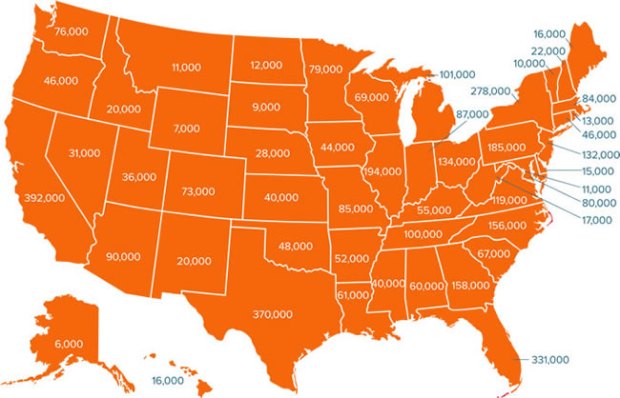
Starting December 1, employees who are paid a salary that is less than $47,476 per year or $913 per week will be eligible for overtime pay (1.5 times regular pay) for hours worked in excess of 40 per week. The Department of Labor estimates this change will affect approximately 4.2 million employees or approximately 19% of all salaried employees nationwide. How employers react in response to this change will determine the actual effects to employees. Here’s a look at the numbers of affected employees by state, including 90,000 in Arizona alone:
What can or should employers do?
The first thing employers should do is communicate with their employees. Based on calls I’ve already gotten from clients, it seems employees are already aware of this change. Even if you haven’t decided on how to respond, let employees know you are aware of the change and that are looking at how it will affect employees and the company.
Since the changes don’t become effective until December, employers have time to analyze different options and choose what works best. Employers should start now (if they don’t already) to track the amount of time affected employees work per week. Some of the different options available to employers are:
- Increase a salaried employee’s pay to meet or exceed the minimum threshold of $47,476.
- Pay time and a half to employees making less than the minimum threshold when they work overtime.
- Limit hours per week or overtime and possibly require employees receive approval prior to working overtime.
- Hire additional employees to handle the work that had been accomplished with overtime.
- Establish a lower hourly pay rate for affected employees such that their regular pay plus average overtime pay is approximately the same as their current salary. (Provided that hourly rate is equal to or greater than the minimum wage of $8.05/hour in Arizona. And this may affect employee morale.)
- Or some combination of these.
What is best for employees and companies will vary by situation. I advise employers to consider the cost of various options along with the effect on employee motivation, morale, and productivity.
When it’s time to implement changes, be sure to communicate those changes with employees, and if any changes are to be made to hours or wages, do it in writing.
If you have questions or want to make sure you are in compliance, feel free to contact me. Initial consultations are free and I enjoy helping employers find a positive solution to employment situations.
Why did the Department of Labor change the law?
The intent of the overtime laws are to require employers to pay a premium to employees required to work more than 40 hours per week. Employers are allowed to designate certain employees as “exempt” from overtime that A) make a “higher” wage (or at least a wage that meets a minimum threshold), and B) exercise a significant amount of discretion over how to do their work. The general idea being that if an employer requires an employee to work more than 40 hours, the employee will be paid extra. If the employee exercises some control over how many hours it takes to complete their weekly work, and they make a minimum salary rate, they don’t have to be paid overtime. There’s more to it than that, but that’s the intent.
Originally established in 1938 with the Fair Labor Standards Act (FLSA), the minimum salary threshold to designate an employee as exempt had not been increased since 2004. In real dollars (accounting for inflation), the minimum salary threshold has taken a precipitous dive of approximately 50% since the late 1970s. It appears the Department of Labor is trying to make up for the decline in this rate over the past 40 years. According to Secretary of Labor, Tom Perez, “If you work full-time in America, you should be able to get by; when you work extra, you should be able to get ahead.”
Having worked with this issue for nearly two decades, I feel the current minimum salary threshold is too low. Employees who met the duties tests of the various exemptions were typically paid much higher salaries than the minimum threshold. Conversely, I came across situations where employees were paid a salary that was at or near the minimum threshold, but did not meet the duties tests, yet the employer did not pay them overtime. Is the new rate the right rate? I don’t know, but it is the rate we are to use starting in six months.
Overview:
The Fair Labor Standards Act of 1938 established a minimum wage and created rules for overtime pay and exemptions for the payment of overtime. The minimum wage varies by region as the federal minimum wage is a baseline that must be adhered to, but states and municipalities can require a higher minimum wage. Some exceptions to the minimum wage are allowed. The current minimum wage for Arizona is $8.05 per hour. Employers are required to pay overtime at time and a half in Arizona to non-exempt employees who work more than 40 hours in a week.
Employers may designate certain employees and positions as exempt from the payment of overtime. In order to make this designation, the employee and position must meet certain requirements. The first requirement is known as the salary test (see the minimum salary threshold discussion above). Then the employee or position must pass the duties test and fall into one of the following classifications as defined by the Department of Labor: Executive, Administrative, Professional, Outside Sales, or Computer Professional. The tests look at the autonomy and responsibilities of the position. There is also an exemption for Highly Compensated Employees whose salary is a minimum of $455 per week and $100,000 in annual compensation – and these numbers will change to $913 per week and $134,000 per year starting December 1, 2016.
Exempt employees are generally paid a wage or salary rate based on the work of the position as opposed to the number of hours they spend working over the course of a week. That salary must be paid on a weekly or less frequent (bi-weekly, semi-monthly, etc.) basis for any period in which work is performed. For a weekly salary basis, an employee who works during the week would be paid the entire week’s salary. Employers should have exempt employees agree to their exempt status in writing.
For more information on these exemptions, either contact Build Up Your People or read more at the Department of Labor’s website here.
 buildupyourpeople.com